
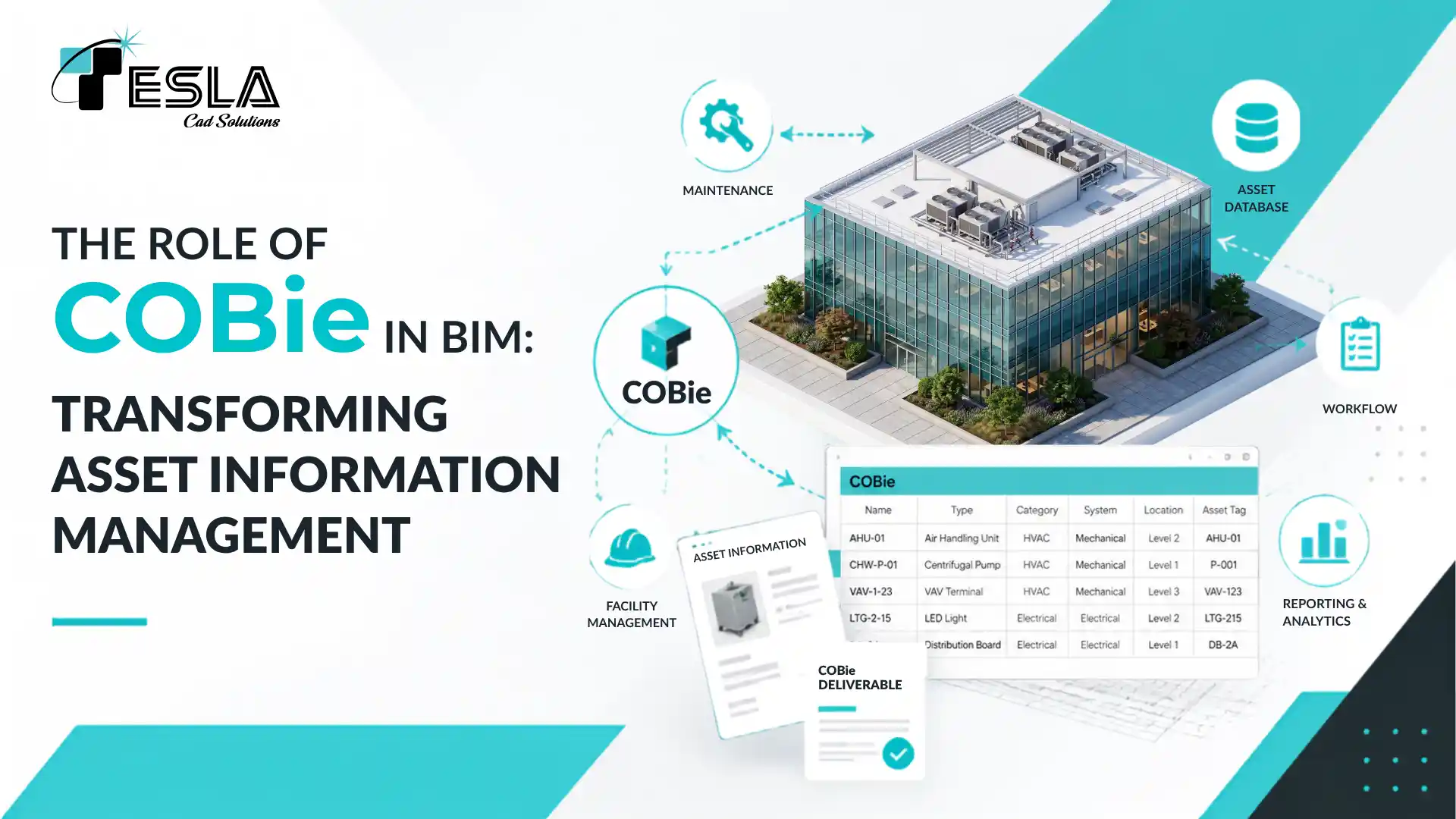
A BIM model contains a vast amount of information about a building, but the real value of that information emerges after construction, when owners and facility managers rely on it to operate and maintain the building efficiently. Unfortunately, that information is often scattered across spreadsheets, manuals, PDFs, and emails, making it difficult to manage throughout the building’s lifecycle.
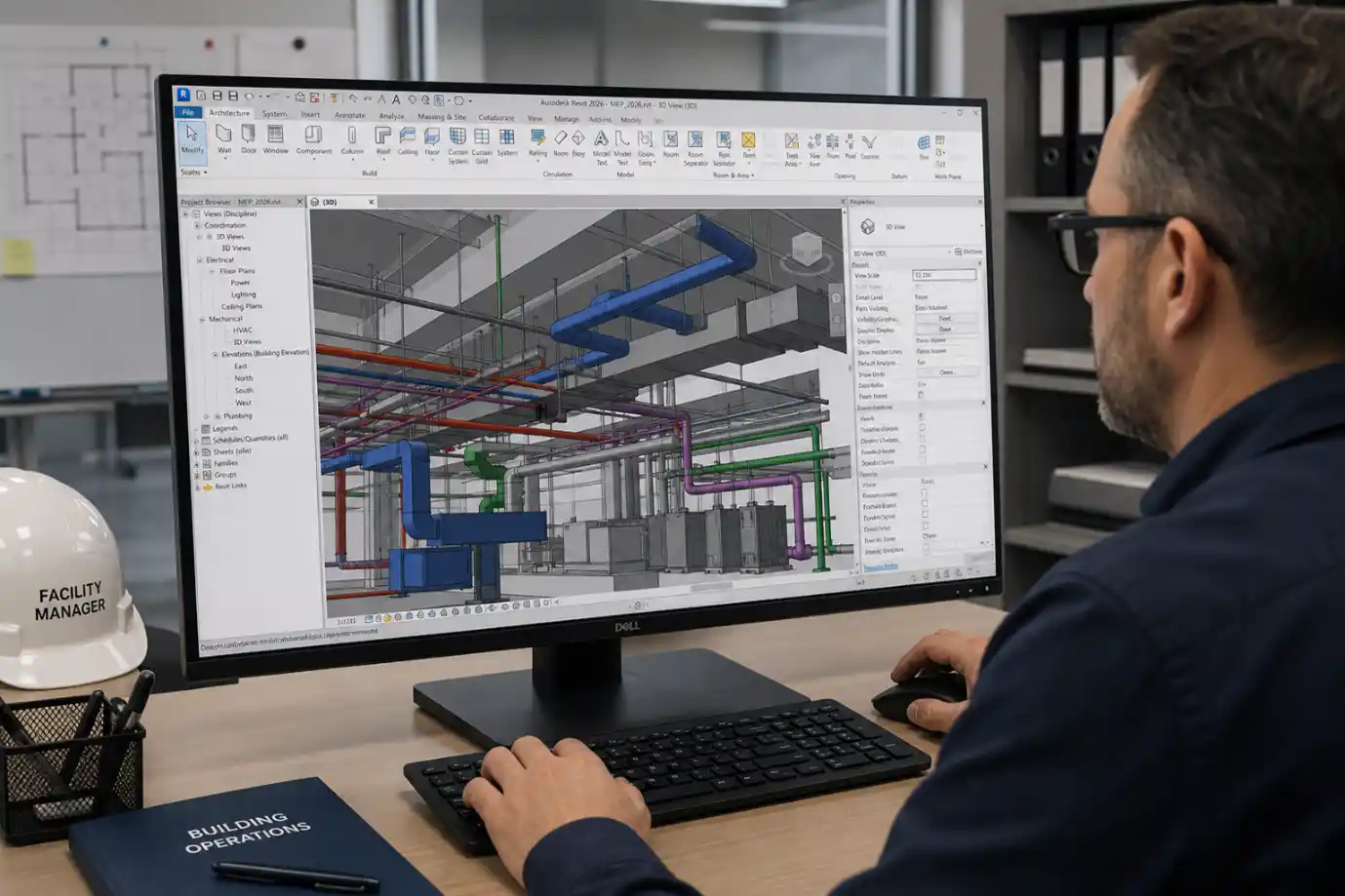
This is where COBie plays an important role. By providing a standardized framework for capturing and delivering building asset information, COBie bridges the gap between BIM and facility management. It ensures that valuable building data remains accessible, organized, and ready for use after construction is complete.
What is COBie?
COBie (Construction Operations Building Information Exchange) is an internationally recognized data exchange standard used to capture, organize, and transfer building asset information throughout a project’s lifecycle.
Rather than focusing on geometric model data, COBie focuses on non-graphical information such as:
- Equipment details
- Product specifications
- Maintenance schedule
- Warranty information
- Spare parts data
- Manufacturer information
- Asset locations
- Operation manuals
COBie allows project teams to deliver structured building asset information that can be used directly by facility and asset management systems.
Why is COBie Important in BIM?
While BIM creates a digital representation of a building, COBie ensures that the information associated with building assets can be effectively transferred and used after project completion.
Did You Know?
The operating phase of a building can account for up to 80% of its total lifecycle cost making COBie-structured handover data one of the highest-leverage deliverables on a project.
Key reasons why COBie is important include:
- Reduces information loss during project handover.
- Standardizes asset data across stakeholders.
- Supports facility and asset management activities.
- Improves maintenance planning and scheduling.
- Eliminates manual re-entry of information.
- Enhances operational efficiency.
- Improves long-term asset performance.
Without a structured data exchange process, valuable information generated during design and construction often becomes difficult to access when it is needed most.
Basic Principles of COBie
COBie is built on a standardized framework that ensures consistent, structured, and efficient information exchange throughout the building lifecycle. Its core principles include:
Format
COBie uses a standardized format, typically a spreadsheet or a digital data exchange, to ensure that information can be consistently shared among project stakeholders and across software platforms.
Data Model
COBie uses a predefined data model that organizes information into categories such as facilities, floors, spaces, systems, components, and maintenance data. This structure keeps information organized and accessible throughout the building lifecycle.
Classification
COBie relies on a standardized classification system to categorize building assets, equipment, and spaces. Consistent classification improves data retrieval, reporting, facility management, and interoperability across systems.
Key COBie Information Categories
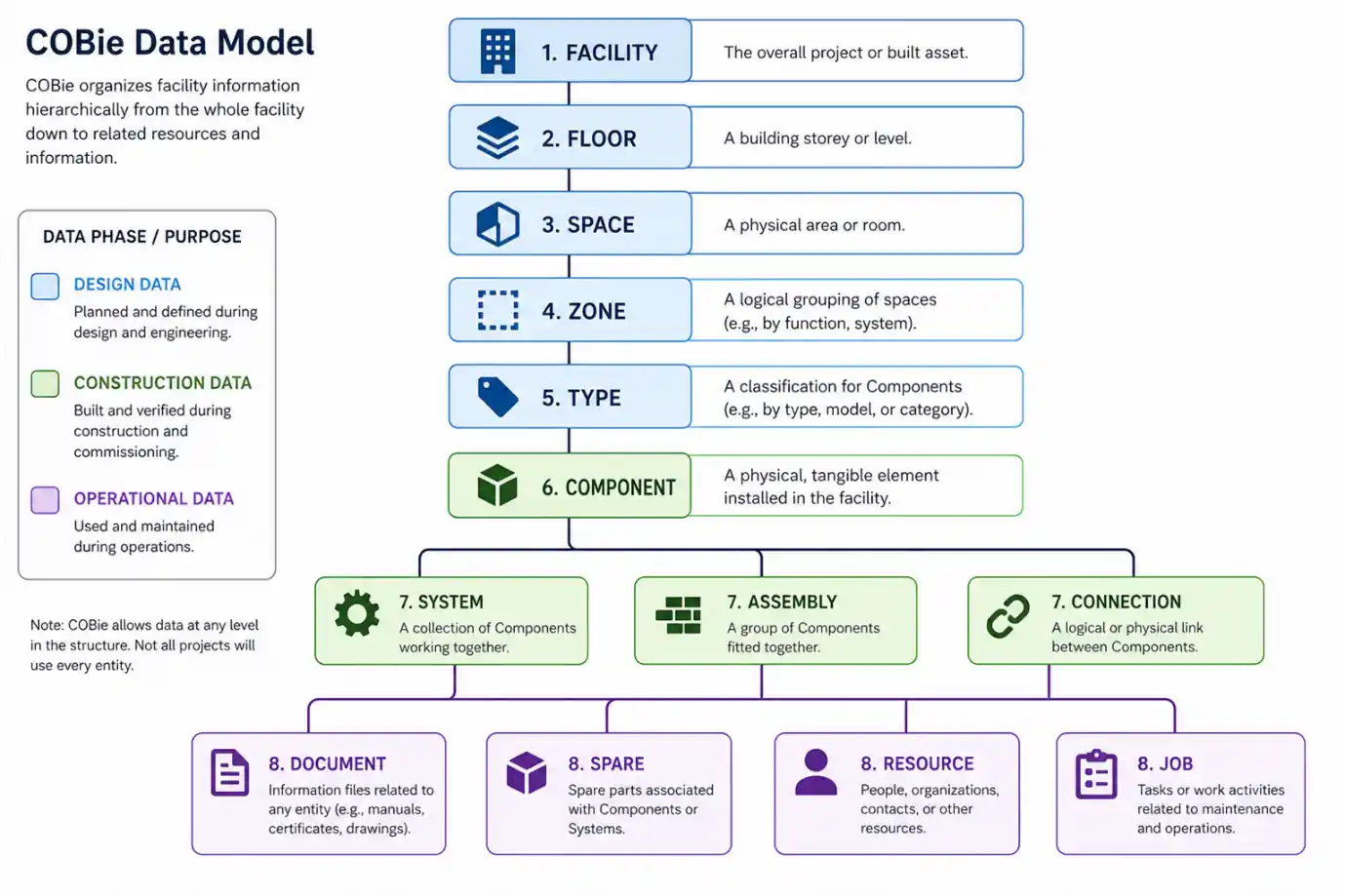
COBie Data Model
Design-Related Information
These categories define the building’s spatial structure and provide the foundation for organizing asset information.
- Facility
General information about the building or project.
- Floor
Details of building levels and floor arrangements.
- Space
Information about rooms and functional areas.
- Zone
Groupings of spaces based on operational or functional requirements.
- Type
Standardized information about the asset types and specifications.
Construction & Asset Information
These categories focus on the assets, systems, and equipment installed during construction.
- Component
Individual building assets and equipment records.
- System
Relationships between components that operate together as a system.
- Assembly
Groups of related building elements and components.
- Connection
Information about how systems and components are linked.
Common Operational Information
These categories support facility management, maintenance, and long-term building operations.
- Document
Manuals, warranties, certificates, and related documentation.
- Spare Parts
Information about replacement components and inventory requirements.
- Resource
Associated resources required for asset operation and maintenance.
- Job
Maintenance and operational tasks linked to building assets.
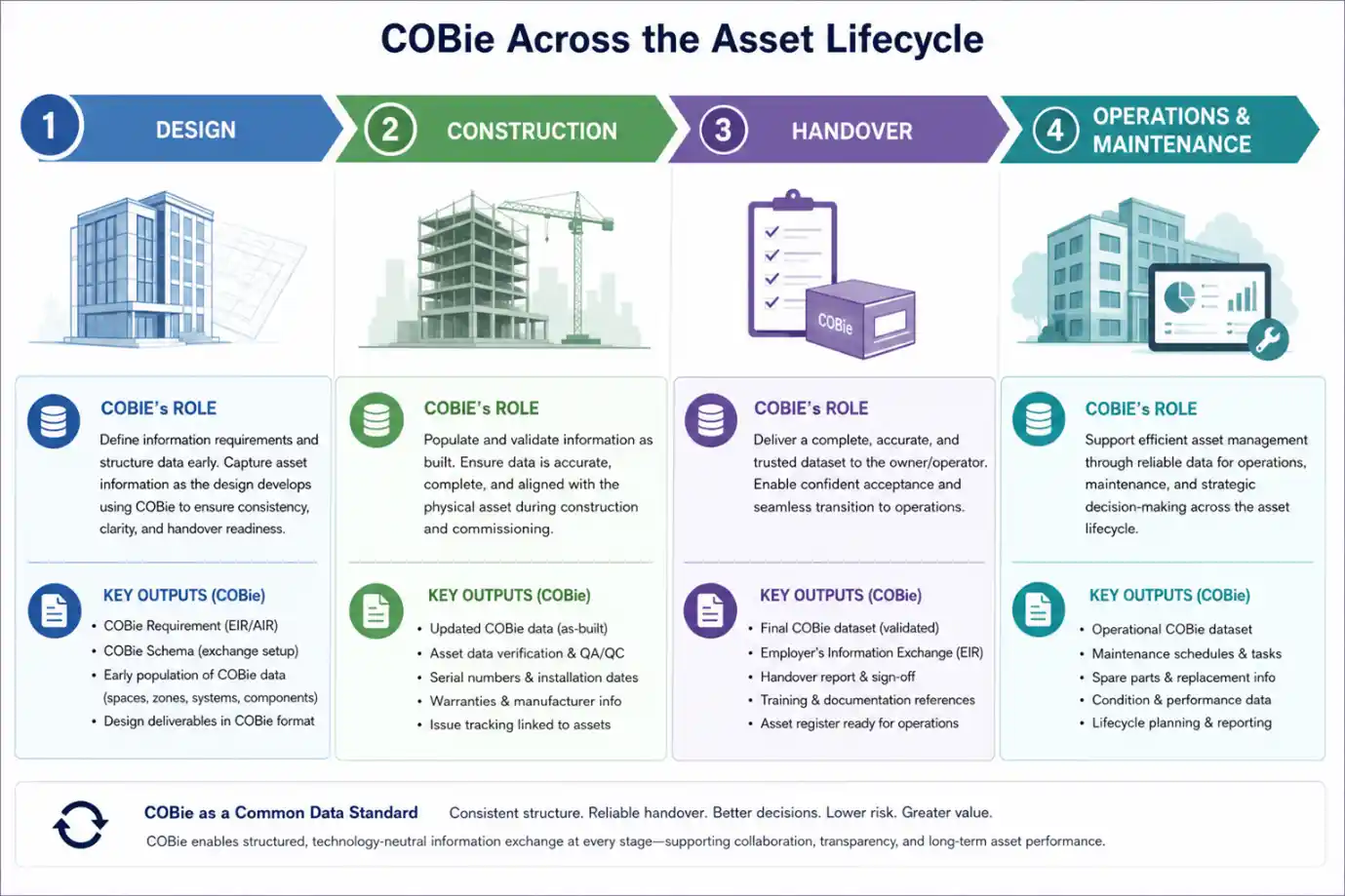
The Role of COBie Throughout the BIM Lifecycle
Design Phase
During design, COBie requirements help establish information standards and asset data requirements from the beginning of the project.
Benefits include:
- Consistent data collection.
- Defined asset information requirements.
- Improved project information planning.
Construction Phase
As construction progresses, equipment and asset information are collected and verified.
Benefits include:
- Accurate product information.
- Better tracking of installed assets.
- Improved documentation management.
Handover Phase
This is where COBie delivers its greatest value.
Instead of handling hundreds of disconnected documents, project teams can provide a structured asset database containing all relevant operational information.
Benefits include:
- Faster project closeout.
- Reduced information gaps.
- More efficient transition to operations.
Operations & Maintenance Phase
Facility managers can use COBie data to support daily operations, maintenance planning, and asset management.
It might surprise you that
Research on BIM–COBie workflows shows an 8.7% reduction in work-order processing time once structured asset data flows directly into CMMS/facility platforms.
Benefits include:
- Faster access to asset information.
- Simplified maintenance scheduling.
- Improved lifecycle management.
- Better decision-making.
Benefits of BIM & COBie Integration
When BIM and COBie work together, organizations can unlock greater value from project information.
Improved Project Handover
The integration of BIM and COBie streamlines the project handover process by providing structured and standardized asset information. Instead of relying on scattered documents and spreadsheets, owners and facility managers receive organized data that is easier to access, understand, and manage throughout the building lifecycle.
Enhanced Data Accuracy
BIM and COBie promote the continuous collection and validation of information throughout the project lifecycle. This reduces manual data entry, minimizes errors, and ensures stakeholders have access to accurate, reliable asset information when making operational and maintenance decisions.
Reduced Manual Data Entry
By capturing asset information directly within BIM workflows, COBie eliminates the need to recreate records after project completion manually. This saves time, improves efficiency, and allows facility management teams to focus on building operations rather than data organization.
Better Collaboration
The combination of BIM and COBie creates a common information framework that supports collaboration among architects, engineers, contractors, owners, and facility managers. With access to consistent, well-organized data, stakeholders can coordinate more effectively and make informed decisions throughout the project lifecycle.
Improved Asset Tracking
COBie provides a centralized repository of asset information that helps organizations monitor, manage, and maintain building components more efficiently. This improved visibility supports maintenance planning, asset performance monitoring, and long -term lifecycle management.
Lower Operational Cost
Accurate and accessible asset information enables facility managers to perform maintenance activities more efficiently and reduce unnecessary downtime. As a result, organizations can lower operational expenses while improving the overall performance and reliability of building assets.
Increased Lifecycle Value
The value of BIM data extends beyond design and construction when combined with COBie. By supporting ongoing facility management, maintenance, and asset planning activities, COBie helps organizations maximize the long-term value and performance of their buildings.
Common Challenges in BIM & COBie Integration
Despite its advantages, successful COBie implementation requires careful planning.
Common challenges include:
- Incomplete asset information.
- Poor data quality.
- Lack of COBie expertise.
- Inconsistent naming conventions.
- Limited stakeholder coordination.
- Software interoperability issues.
- Late-stage data collection efforts.
Many projects treat COBie as a handover requirement rather than an ongoing information management process, which often results in incomplete deliverables.
Best Practices for Successful BIM & COBie Integration
Organizations can improve COBie outcomes by following several best practices.
Define Requirements Early
Establish COBie requirements during the project’s planning stage. Clearly defining deliverables, data fields, and stakeholder responsibilities early helps prevent information gaps and reduces rework later in the project lifecycle.
Establish Data Standards
Use consistent naming conventions, classification systems, and asset identification methods across the project. Standardized data improves accuracy, simplifies information exchange, and ensures compatibility with downstream systems.
Assign Data Ownership
Clearly identify who is responsible for creating, updating, and validating COBie information at each project stage. Defined ownership improves accountability and helps maintain data quality throughout the lifecycle.
Validate Data Regularly
Conduct periodic reviews and quality checks to ensure information remains accurate and complete. Regular validation helps identify errors early, reducing the risk of costly corrections at project handover.
Automate Data Collection
Leverage BIM tools and automated workflows to capture asset information directly from project models. Automation reduces manual effort, improves efficiency, and minimizes the likelihood of data entry errors.
Train Project Teams
Ensure all stakeholders understand COBie requirements, workflows, and data management practices. Proper training improves collaboration and helps teams consistently deliver high-quality information throughout the project.
How does BIM & COBie Integration Benefit the Multiple Stakeholders within the AEC Industry
Architects & Engineers
- Improved information coordination.
- Better alignment with client requirements.
Project Managers
- Better information governance.
- Improved data consistency across projects.
Contractors
- Streamlined project closeout.
- Reduced handover issues.
- Improved documentation management.
Facility Managers
- Faster access to maintenance information.
- Improved asset management.
- Reduced operational disruptions.
Building Owners
- Better visibility of building assets.
- Improved lifecycle planning.
- Enhanced return on investment.
Future of COBie in BIM
As digital transformation continues across the AEC industry, the role of COBie is expected to expand significantly.
One Key Insight
The global BIM market is projected to grow from USD 9.03B in 2025 to USD 15.42B by 2030 at an 11.3% CAGR, accelerating owner mandates for COBie-compliant deliverables.
Emerging developments include:
- Integration with digital twins.
- Smart building management systems.
- IoT-enabled asset monitoring.
- Cloud-based facility management platforms.
- AI-driven maintenance planning.
- Data-driven asset performance analysis.
The future of BIM is increasingly focused on information rather than geometry alone. In this environment, COBie serves as a critical link between design, construction, operations, and long-term asset management.
Did You Know?
The digital twins market is projected to grow from USD 29.63B (2025) to USD 42.04B (2026), driving demand for COBie-structured asset data to feed live twins.
COBie Services by Tesla CAD Solutions
Tesla CAD Solutions provides comprehensive COBie solutions that help organizations streamline BIM data delivery and facility management workflows.
Our services include:
- COBie data creation and population.
- BIM-to-COBie conversion.
- Asset information management.
- COBie compliance reviews.
- Data validation and quality assurance.
- BIM coordination and information management support.
By combining BIM expertise with structured information management practices, we help clients deliver accurate, complete, and facility management-ready COBie datasets.
Conclusion
COBie plays a critical role in maximizing the long-term value of BIM data. Standardizing the collection, organization, and exchange of asset information enables a seamless transition from design and construction to facility operations.
As the industry continues to embrace digital delivery, smart buildings, and data-driven asset management, COBie will become increasingly important for ensuring that building information remains accurate, accessible, and actionable throughout the entire asset lifecycle. Organizations that integrate COBie into their BIM strategy today will be better positioned to achieve efficient handovers, improved operational performance, and greater value from their built assets.
FAQ’s
Can COBie be generated from existing BIM models?
Yes. Most modern BIM platforms can export COBie-compliant data when models are developed in accordance with established information requirements. However, the quality of the COBie deliverable depends on the accuracy and completeness of the information contained within the BIM model.
What software supports COBie workflows?
Several BIM and facility management platforms support COBie, including Revit, ArchiCAD, Navisworks, IFC-based workflows, and various CMMS (Computerized Maintenance Management Systems). The specific workflow depends on project requirements and software ecosystems.
How does COBie support facility management after project completion?
COBie provides facility managers with structured asset information, including equipment details, maintenance schedules, warranty data, and operational documents. This allows faster maintenance planning, improved asset tracking, and more informed operational decision-making throughout the building lifecycle.
Need COBie-ready BIM deliverables? Partner with our experts to streamline handover and unlock long-term asset value.