
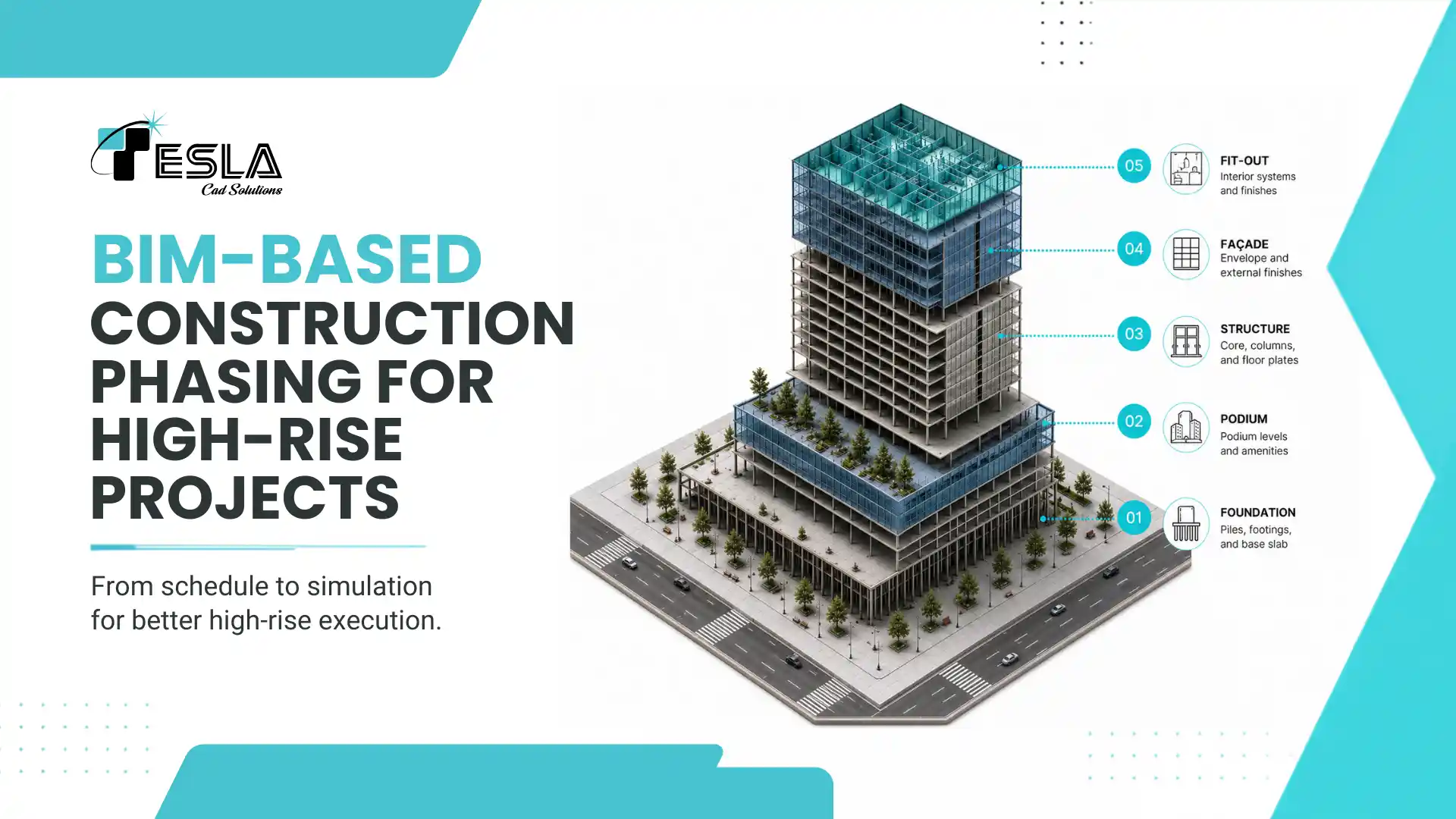
Constructing a high-rise building is much more than stacking floors. Every stage of construction must happen in the right sequence and at the right time. A single scheduling conflict can disrupt various project stakeholders, create safety risks, and affect overall project delivery.
Traditionally, construction teams relied on tools such as Gantt charts and the Critical Path Method (CPM) to plan project activities. While these tools provide timelines, they often make it difficult to visualize how construction tasks interact in a complex high-rise environment. As buildings become taller and more technically complex, project teams need a clearer way to understand construction sequencing before on-site work begins.
This is where BIM-based construction phasing plays an important role. By integrating 3D building models with project schedules, BIM enables the teams to simulate the entire construction process virtually, resulting in a coordinated, efficient, and predictable approach to project execution. This helps project stakeholders identify potential challenges early and optimize construction strategies throughout the project lifecycle.
What is BIM-Based Construction Phasing?
Construction phasing refers to the process of dividing a project into small, planned stages and defining the sequence in which construction activities will be executed.
When Building Information Modeling (BIM) is integrated with project schedules, it creates a 4D BIM model that adds the dimension of time to a 3D model. Teams can visualize how structural, architectural, and MEP components will be constructed over days, weeks, or months.
Did You Know?
The 4D BIM market reached USD 1.22 billion in 2025, representing a 26% share of the total BIM market, fueled by rising demand for project lifecycle visualization and risk assessment tools in large-scale infrastructure developments.
Rather than relying solely on schedules, project teams can watch a virtual simulation of the building’s construction step by step.
Why High-Rise Projects Require BIM-Based Construction Phasing
High-rise buildings face challenges that are difficult to manage through traditional planning methods alone.
Some common complexities include:
- Floor-by-floor construction sequencing.
- Vertical transportation of labor and materials.
- Tower crane coordination.
- Coordination of multiple Coordination teams working across various levels.
- Limited staging and storage area.
- Safety management in an active construction zone.
- Tight project delivery schedules.
For example,
If façade installation begins before structural activities reach the required stage, workers may face access restrictions, resource conflicts, and costly reworks.
BIM-based construction phasing allows teams to evaluate these scenarios in advance and adjust construction sequences accordingly.
How BIM-Based Construction Phasing Works
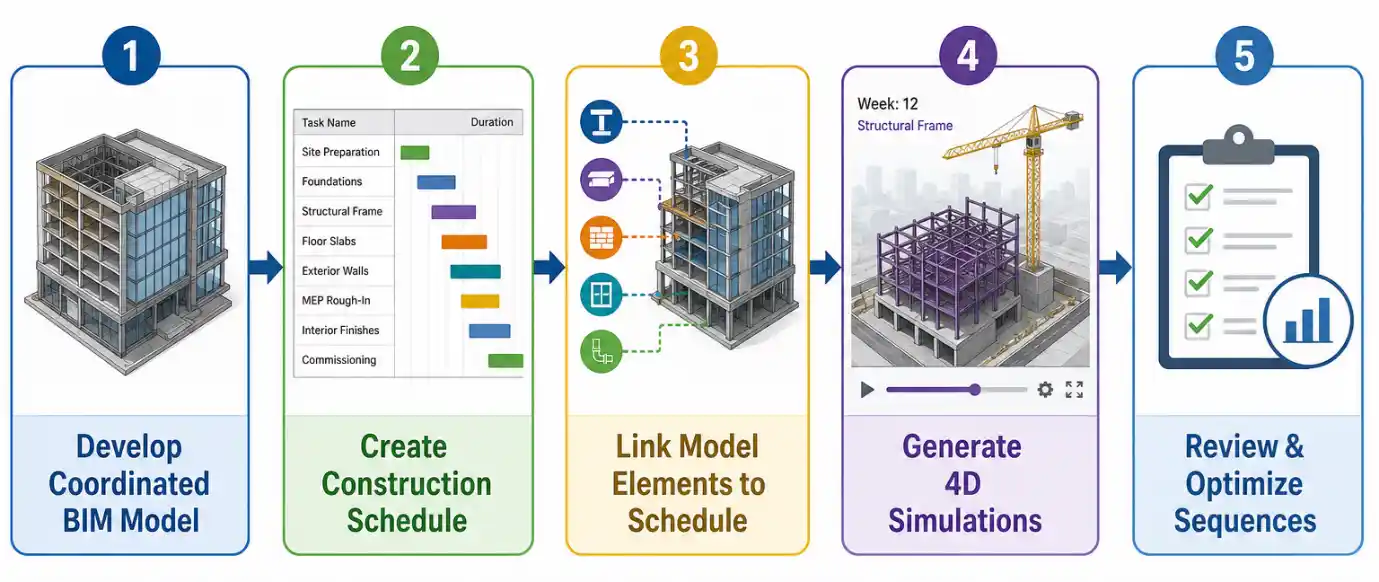
5-Step BIM-Based Construction Phasing Workflow
1. Develop a Coordinated BIM Model
Architectural, structural, and MEP models are developed and integrated to establish an accurate digital representation of the building.
2. Create the Construction Schedule
The scheduling software specifies project activities, milestones, durations, and dependencies.
3. Link Model Elements to Schedule Activities
Building components are connected to the corresponding construction tasks, creating a relationship between physical elements and project timelines.
4. Generate 4D Construction Simulations
The model visualizes how the building will progress throughout the different construction phases.
5. Review & Optimize Sequences
Project teams use the simulation to identify inefficiencies, conflicts, safety concerns, or scheduling risks before construction begins.
Key Applications of BIM-Based Construction Phasing in High-Rise Projects
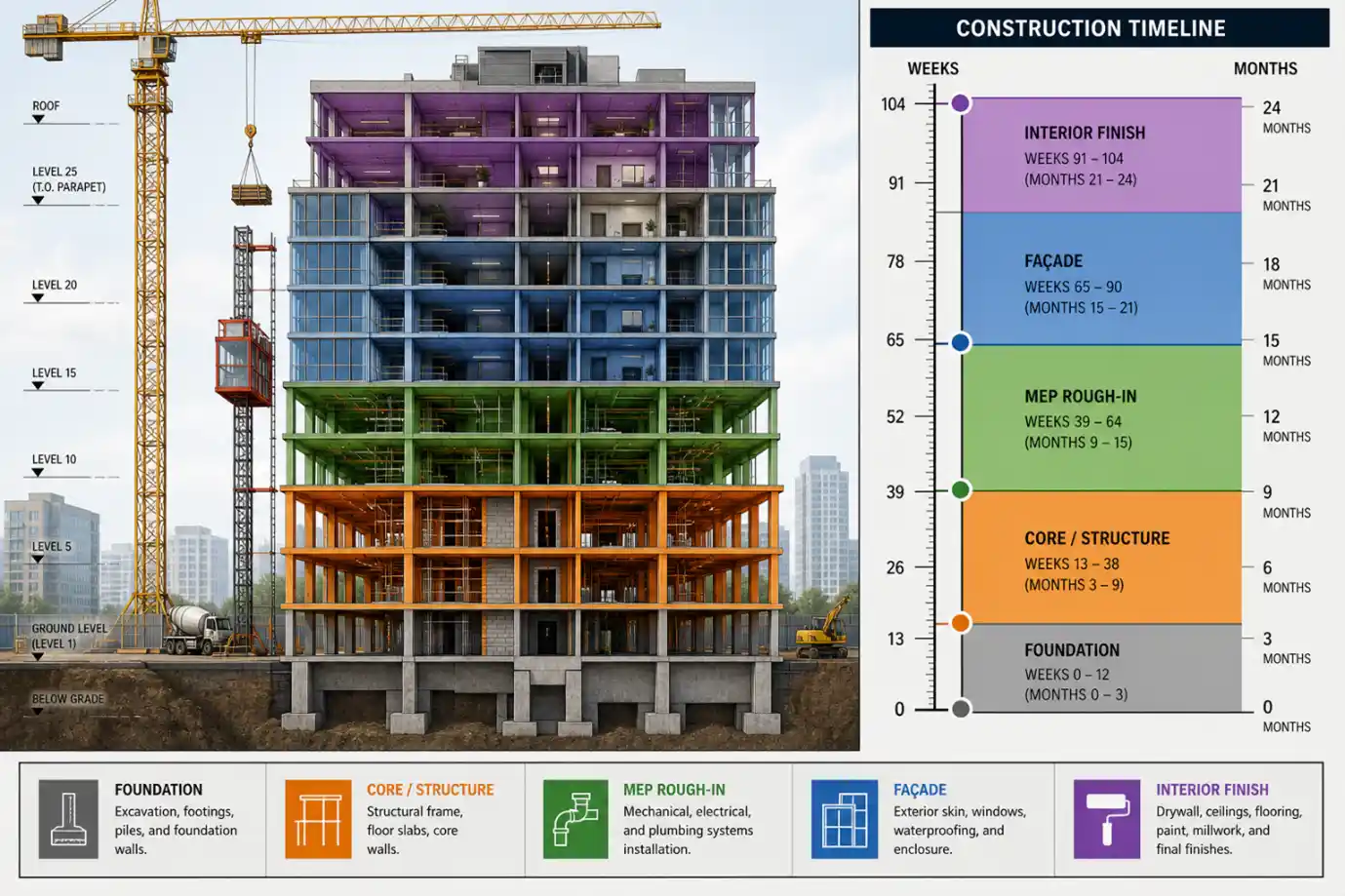
4D Phasing of a High-Rise: Vertical Construction Timeline
| Application | Benefit |
| Structural Frame Construction | Visualizes floor-by-floor progress. |
| Core Wall Construction | Improves sequencing of vertical elements. |
| Façade Installation | Minimizes clashes with ongoing construction activities. |
| MEP Installation | Supports the efficient sequencing of building services. |
| Tower Crane Operations | Optimizes crane positioning and lifting schedules. |
| Material Logistics | Reduces site congestion and material handling issues. |
| Site Logistics Planning | Validates site access and staging area. |
| Construction Safety Planning | Identifies potential hazards before execution. |
Benefits of BIM-Based Construction Phasing in High-Rise Projects
Improved Schedule Reliability
BIM-based construction phasing enables project teams to visualize construction sequences before work begins. By identifying potential scheduling conflicts and dependencies early, teams can optimize workflows and minimize delays. This leads to more predictable project timelines and smoother execution across multiple floors and construction stages.
Did You Know?
Projects adopting 4D and 5D BIM workflows report up to 20–30% improvements in schedule reliability and cost predictability compared with traditional planning methods.
Enhanced Coordination between Trades
High-rise projects involve numerous teams working simultaneously across different levels of the building. BIM-based construction phasing provides a shared visual platform that helps stakeholders understand when and where activities will take place. This improves communication, reduces coordination issues, and supports more efficient project delivery.
Better Site Safety
Construction phasing simulations allow teams to evaluate site conditions and planned activities before execution. Potential safety hazards related to worker access, material movement, and overlapping operations can be identified and addressed in advance. This contributes to a safer and more organized construction environment.
Reduced Rework
Sequencing errors and coordination issues can result in costly modifications during construction. BIM-based construction phasing helps teams detect potential conflicts before they reach the site, enabling corrective actions during the planning stage. This reduces rework, material waste, and disruptions to project schedules.
Did You Know?
Construction rework costs the U.S. construction industry an estimated $31.3 billion every year, with rework accounting for 5–9% of total project costs, losses that early-stage 4D phasing directly helps minimize.
Improved Stakeholder Communication
Complex construction schedules can be difficult for clients and project stakeholders to interpret. BIM-based construction phasing transforms schedules into visual simulations, making project timelines and construction sequences easier to understand. This supports better decision-making and alignment among all project participants.
More Efficient Resource Planning
High-rise construction requires careful management of labor, equipment, and materials throughout different project phases. BIM-based construction phasing helps teams plan resource allocation based on actual construction progress and site conditions. As a result, resources can be utilized more efficiently, reducing downtime and improving productivity.
Best Practices for Successful BIM-Based Construction Phasing in High-Rise Projects
- Developing construction phasing strategies during the early planning stages.
- Maintaining accurate and regularly updated BIM models.
- Involving contractors and site teams in construction phasing reviews.
- Conducting periodic 4D coordination meetings.
- Aligning schedule updates with BIM model revisions.
- Using construction phasing simulations for safety and logistics planning.
- Reviewing alternative sequencing options before finalizing schedules.
The Future of BIM-Based Construction Phasing in High-Rise Projects
As high-rise buildings become more complex, BIM-based construction phasing is expected to play an even greater role in project planning and execution. Emerging technologies are transforming BIM from a visualization tool into a more intelligent and data-driven construction management solution.
Key trends shaping the future include:
- AI-assisted construction planning to optimize schedules and identify potential project risks.
- Digital twin integration for comparing planned construction activities with actual site progress.
- Real-time progress monitoring through drones, IoT devices, and reality capture technologies.
- Cloud-based collaboration that enables stakeholders to access and review project information from anywhere.
- Integration with 5D and 6D BIM to connect construction phasing with cost management and facility operations.
As these technologies continue to evolve, BIM-based construction phasing will help project teams make faster decisions, improve coordination, and achieve greater control over complex high-rise construction projects. This will contribute to more efficient project delivery, enhanced safety, and improved overall project outcomes.
Conclusion
Managing high-rise construction requires careful coordination of people, resources, schedules, and site operations. Traditional planning methods often struggle to effectively communicate the complexity of modern high-rise projects.
BIM-based construction phasing addresses this challenge by combining visualization with scheduling intelligence. Through 4D simulations, project teams can evaluate construction sequences, improve collaboration, reduce risks, and optimize project delivery before physical work begins.
As the construction industry continues to embrace digital transformation, BIM-based construction phasing is becoming an essential tool for delivering high-rise projects more safely, efficiently, and predictably.
FAQ’s
Which BIM software is commonly used for construction phasing?
Several BIM platforms support construction phasing and 4D simulation, including Autodesk Navisworks, Synchro 4D, Bentley OpenBuildings, and Revitzo. The choice of software depends on project requirements, team workflows, and integration needs.
What information is required to create a BIM-based construction phasing model?
Creating a BIM-based construction phasing model typically requires a coordinated BIM model, a detailed construction schedule, activity durations, task dependencies, and project milestones. Accurate project data is essential for generating reliable phasing simulations and construction sequences.
Can BIM-based construction phasing be used for ongoing projects?
Yes. BIM-based construction phasing can be implemented during both the planning and construction stages. For ongoing projects, it can help assess progress, update schedules, evaluate alternative construction sequences, and improve coordination among project teams.
Planning a high-rise project? Partner with our BIM experts for precise 4D phasing and seamless project delivery.